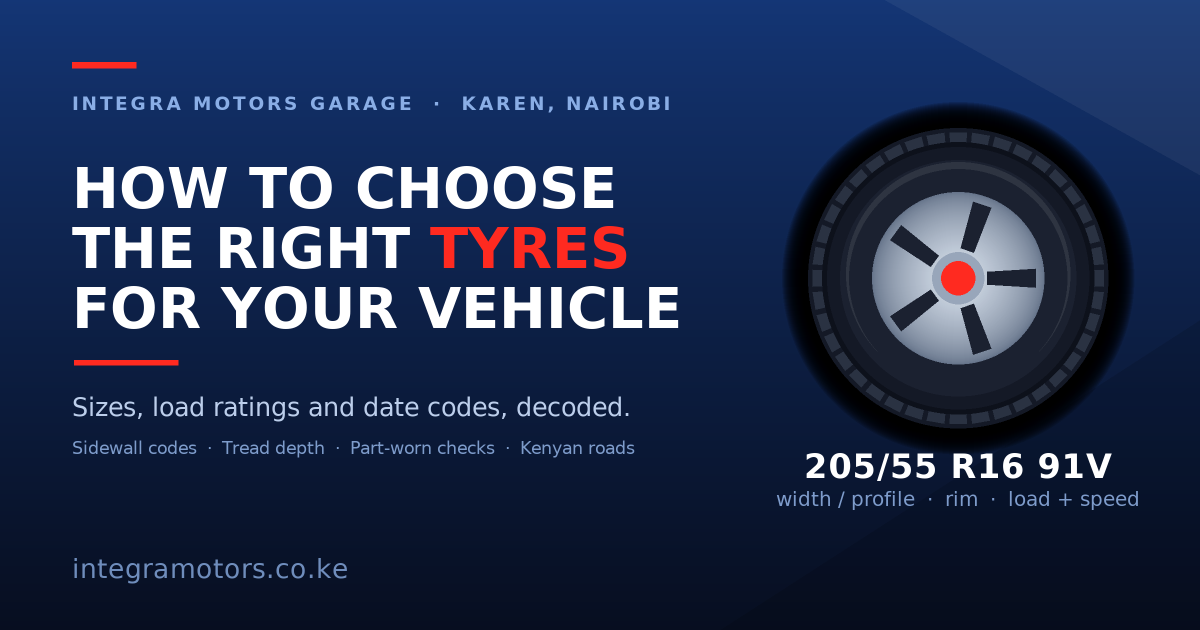
How to Choose the Right Tyres for Your Vehicle
Your tyres are the only part of your car that ever touches the road. Everything the engine, brakes and steering do has to pass through four contact patches, each roughly the size of your palm. Get the choice right and the car stops shorter, holds the road in rain, rides quieter and uses less fuel. Get it wrong and no amount of servicing compensates.
Choosing tyres in Kenya carries complications drivers elsewhere do not face: potholes, murram sections, long hot tarmac stretches, and a very large market in part-worn imported tyres of unknown history. This guide covers how to read a sidewall, how to check age, what actually suits Kenyan roads, and when to replace. At Integra Motors Garage in Karen, it is one of the questions our technicians answer most.
The Short Answer
- Match the size on your door placard, not whatever the shop has in stock. The placard inside the driver’s door frame is the authority, not the tyres currently fitted, which may already be wrong.
- Never go below the load index or speed rating your manufacturer specifies. This is a safety limit, not a suggestion.
- Check the DOT date code. Rubber ages whether or not it is driven on. A five year old tyre with full tread is not a bargain.
- Replace in pairs at minimum, across the same axle, and match brand and pattern on that axle.
How to Read a Tyre Sidewall
Every tyre carries its specification moulded into the sidewall. A common Kenyan size reads 205/55 R16 91V. Each part means something specific, standardised internationally by bodies such as the European Tyre and Rim Technical Organisation.
| Marking | Meaning | Why it matters |
|---|---|---|
| 205 | Section width in millimetres | Wider grips more but costs fuel and can aquaplane sooner |
| 55 | Aspect ratio: sidewall height as a percentage of width | Lower is sharper steering but a harsher ride over potholes |
| R | Radial construction | Effectively universal on modern cars |
| 16 | Rim diameter in inches | Must match your wheel exactly |
| 91 | Load index (91 = 615 kg per tyre) | Never fit lower than specified |
| V | Speed rating (V = 240 km/h) | Relates to heat tolerance, not just top speed |
The speed rating point is widely misunderstood. Nobody drives at 240 km/h in Nairobi, but the rating reflects how well the carcass sheds heat under sustained load. A lower rated tyre on a hot afternoon run to Mombasa, fully loaded, is working closer to its limit than the number suggests.
Common Load Indexes and Speed Ratings
| Load index | Capacity per tyre | Speed symbol | Maximum speed |
|---|---|---|---|
| 82 | 475 kg | T | 190 km/h |
| 88 | 560 kg | H | 210 km/h |
| 91 | 615 kg | V | 240 km/h |
| 95 | 690 kg | W | 270 km/h |
| 100 | 800 kg | Y | 300 km/h |
Check the Age, Not Just the Tread
This is the single most overlooked check in the Kenyan market. Every tyre carries a DOT code ending in four digits inside an oval. The first two are the week of manufacture, the last two the year. A tyre stamped 2621 was built in week 26 of 2021.
Rubber oxidises and hardens with time regardless of mileage, and heat accelerates it. A tyre that has sat in a yard for years can show deep tread yet have lost much of its wet grip, with sidewalls prone to cracking. As a working rule, treat anything over five years from manufacture with caution and anything over ten as due for replacement whatever the tread looks like.
Always check the date on a “new” tyre before you pay. Stock sits in warehouses, and the difference between a tyre made last year and one made six years ago is not reflected in the price you are quoted.
Match the Tyre to How You Actually Drive
| Type | Best for | Trade-off |
|---|---|---|
| Highway / HT | Tarmac commuting, saloons and urban SUVs | Limited grip on wet murram or mud |
| All-terrain / AT | Mixed tarmac and rough roads, upcountry travel | Noisier, slightly higher fuel use |
| Mud-terrain / MT | Genuine off-road and site work | Loud, poor wet tarmac braking, wears fast |
| Touring / comfort | Long tarmac distances, quiet ride | Softer sidewalls are vulnerable to potholes |
Be honest about the split. Most Nairobi SUVs spend well over 90% of their life on tarmac, and fitting aggressive mud-terrains for the occasional weekend trip means paying every day in noise, fuel and longer wet stopping distances. All-terrains are usually the better compromise.
Tread Patterns
- Symmetric: same pattern across the tyre. Cheapest, quiet, long wearing, and can be rotated in any direction.
- Directional: V shaped, designed to pump water outwards. Strong in the wet, but must be fitted the correct way round, which limits rotation options.
- Asymmetric: different inner and outer halves, combining wet drainage with dry cornering grip. Must be fitted with the correct face outward.
Directional and asymmetric tyres are regularly fitted the wrong way round by rushed fitters. Check the arrow or the “OUTSIDE” marking before you drive away, because a reversed tyre loses much of the wet performance you paid for.
New or Part-Worn? An Honest Answer
Imported part-worn tyres are a large part of the Kenyan market, and pretending otherwise helps nobody. They are cheaper up front. The problem is what you cannot see: you have no record of how the tyre was driven, whether it was run underinflated, whether it struck a kerb hard enough to damage internal cords, or whether it was ever repaired badly.
If budget makes part-worn the realistic choice, reduce the risk deliberately:
- Check the DOT date first and reject anything old regardless of tread
- Insist on at least 4 mm of even tread, not the legal minimum
- Inspect both sidewalls for cracks, bulges, cuts and plug repairs
- Look inside the tyre for patches or exposed cords
- Reject uneven wear, which signals the previous car had alignment or suspension faults
- Buy matching pairs, never one odd tyre per axle
Counterfeit and substandard products are a recognised problem regionally, and the Kenya Bureau of Standards operates a standardisation mark scheme for exactly this reason. Buy from established suppliers and check for proper markings. A tyre is the last component worth economising on.
What Kenyan Roads Do to Tyres
- Potholes. A hard edged hit can pinch the sidewall against the rim and break internal cords. Damage often shows later as a bulge, which means the tyre must be replaced, not repaired.
- Murram and gravel. Sharp stones cut tread blocks and lodge in grooves. Higher sidewalls and tougher casings survive far better than low profile tyres.
- Heat. Hot tarmac raises running temperature, and an underinflated tyre flexes more, builds more heat, and fails sooner.
- Speed bumps and unmarked humps. Repeated impacts punish both tyres and suspension. Persistent knocking after bumps usually points to worn components rather than the tyres themselves, and is worth a suspension and steering inspection.
- Load. Carrying heavy loads regularly means respecting the load index and raising pressures to the manufacturer’s laden figure.
The practical consequence: on Kenyan roads a slightly higher profile with a tougher casing usually outlasts and outperforms a low profile tyre chosen purely for looks.
When to Replace
Tyres carry moulded tread wear indicators in the main grooves, set at 1.6 mm. Once the tread is level with those bars the tyre is finished. In practice wet braking degrades sharply below about 3 mm, so on roads that flood as quickly as Nairobi’s do, replacing at 3 mm rather than 1.6 mm is money well spent. Roadworthiness requirements are set by the National Transport and Safety Authority, so check current rules if your vehicle is due for inspection.
Replace immediately, regardless of tread depth, if you find a sidewall bulge, a cut deep enough to expose cords, cracking across the sidewall, or vibration that persists after balancing.
What Uneven Wear Is Telling You
| Wear pattern | Likely cause | Action |
|---|---|---|
| Both edges worn, centre fine | Chronic underinflation | Correct pressures and check for leaks |
| Centre worn, edges fine | Overinflation | Set to placard pressure |
| One edge only | Camber or toe misalignment | Wheel alignment |
| Feathered or saw toothed edges | Toe misalignment | Wheel alignment |
| Patchy cupping or scalloping | Worn shocks or bushes | Suspension inspection |
Fitting new tyres without fixing the cause simply destroys the new set at the same rate. If the old tyres show any of the patterns above, correct the underlying fault first. Cupping in particular often traces back to worn shocks or hub bearings, and we stock genuine suspension and steering components for the common Japanese models on Kenyan roads.
Pressure, Rotation, Balancing and Alignment
- Pressure: check monthly when cold, using the placard figure, not the number moulded on the tyre, which is a maximum rather than a recommendation. Underinflation is the leading cause of premature wear and heat failure.
- Rotation: every 8,000 to 10,000 km to even out wear, following the pattern your tyre type allows.
- Balancing: whenever a tyre is fitted, and again if you feel vibration through the wheel at speed.
- Alignment: after fitting new tyres, after any significant pothole strike, and whenever the car pulls to one side.
Worn tyres lengthen stopping distances, but so do tired brakes, and the two are easy to confuse. If stopping feels different, read our guide to the warning signs that brakes need attention or book a brake system inspection.
Buying: Pairs, Sets and Spares
Fit tyres in pairs across an axle at minimum, matching brand, pattern and size. Mixing different patterns on one axle gives the two sides different grip levels, which shows up exactly when you least want it, under hard braking in the wet.
When only two are replaced, put the new pair on the rear axle, even on a front wheel drive car. Worn rears let the back of the car step out under braking in the wet, and that is far harder to correct than front understeer. Check your spare too, including its pressure and date code, because a flat or perished spare is discovered at the worst possible moment.
Buying a Used Car? Read the Tyres
Tyres are one of the most informative parts of a used car inspection. Four mismatched brands suggest cheap ad hoc replacement. Uneven wear points to alignment or suspension faults the seller may not mention. Old date codes on deep tread suggest a car that has stood unused. Our pre-purchase inspection covers all of this before you commit.
Common Mistakes
- Buying on price alone. The cheapest tyre is rarely cheapest per kilometre once wear rate is counted.
- Copying the fitted size. If a previous owner fitted the wrong size, you inherit the mistake. Use the door placard.
- Ignoring the date code. Tread depth says nothing about rubber age.
- Skipping alignment. A new set can be ruined within months by an uncorrected fault.
- Fitting new tyres to the front only. New rubber belongs on the rear when replacing just two.
- Upsizing for appearance. Larger rims with thinner sidewalls look sharper and suffer badly on potholed roads.
Frequently Asked Questions
How long do tyres last in Kenya?
Typically 40,000 to 60,000 km on mostly tarmac driving, though rough roads, heavy loads and hot conditions shorten that. Age matters independently: replace on time even if tread remains, because rubber hardens as it ages.
Can I fit a different size from the one on my car?
Only within the manufacturer’s approved options. Changing size alters speedometer accuracy, ABS and stability control calibration, load capacity and clearance. If in doubt, stay with the placard size.
Are part-worn imported tyres safe?
Some are serviceable, many are not, and you cannot tell the history from the outside. If you buy them, check the date code, insist on 4 mm or more of even tread, inspect sidewalls and the inner casing, and buy matched pairs. New tyres remain the safer choice.
How often should I check tyre pressure?
Monthly, and before any long trip, always when the tyres are cold. Underinflation is the most common and most damaging tyre fault, and it raises fuel consumption at the same time.
Do I need to replace all four at once?
Not necessarily, but replace at least two across the same axle. All four wheel drive vehicles are the exception: many require all four to be replaced together, because differing rolling diameters can damage the drivetrain. Check your manual.
What does the tread wear indicator look like?
Small raised bars sitting in the main grooves, at 1.6 mm. When the surrounding tread wears level with them, the tyre is finished. Look for small triangles or “TWI” on the sidewall showing where they sit.
Get the Right Set Fitted Properly
Choosing tyres is not about buying the most aggressive looking pattern. It is about matching size, load index and speed rating to your vehicle, picking a type that suits how you actually drive, checking the age before you pay, and correcting any alignment or suspension fault so the new set lasts.
Our technicians at Integra Motors Garage, opposite Galleria Mall in Karen, Nairobi, will confirm the correct specification for your vehicle, inspect wear patterns for underlying faults, and put things right. Book a service online, browse the shop for genuine parts, see our full range of garage services, or talk to our team.
Keep reading: Synthetic vs Conventional Oil: Which Does Your Engine Need?, 5 Signs Your Brakes Need Immediate Attention and How to Choose a Reliable Car Garage in Nairobi.