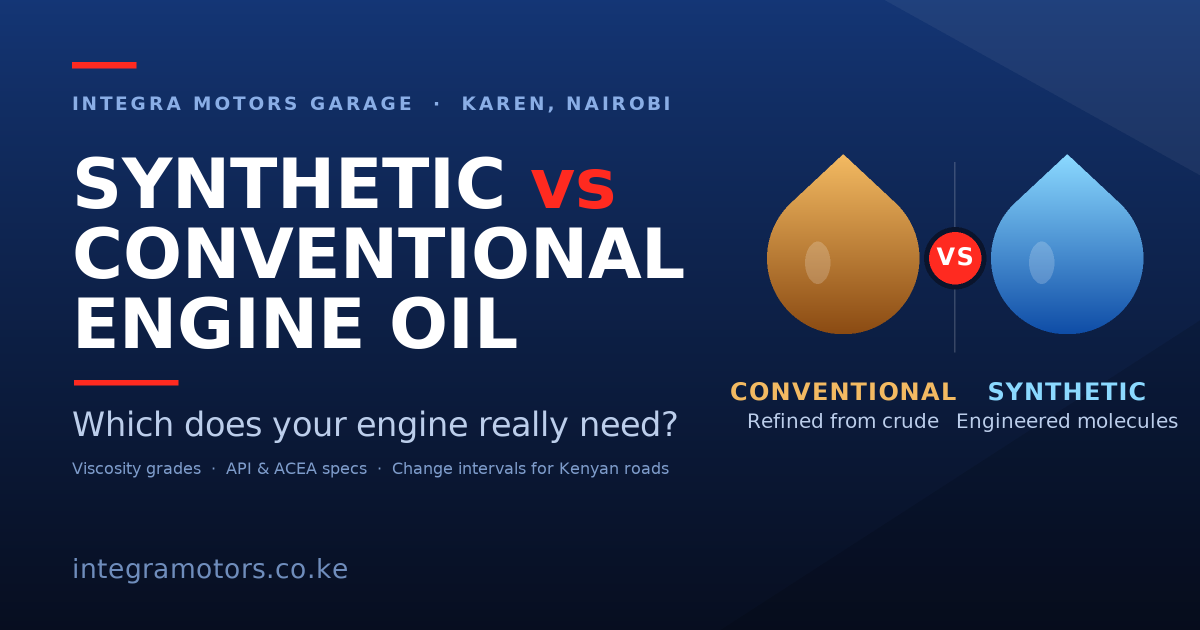
Synthetic vs Conventional Oil: Which Does Your Engine Need?
Walk into any parts shop in Nairobi and ask for engine oil, and you will be offered three or four options for the same car, at three or four very different prices. One tin says fully synthetic, another says semi-synthetic, and the cheapest simply says mineral. Most drivers pick on price alone, then wonder why the engine feels rough at 120,000 km.
The honest answer is that the right oil is the one your manufacturer specified, and for the majority of cars on Kenyan roads today, that is a synthetic. Below we explain the real differences, how to read the label, and how Nairobi driving conditions change the calculation. At Integra Motors Garage in Karen, this is one of the questions our technicians answer most often.
The Short Answer
- Modern car (roughly 2010 onward), turbocharged, or direct injection? Use a full synthetic that meets the grade and specification in your owner’s manual. It is not optional on most of these engines.
- Older, high-mileage, naturally aspirated engine driven gently? A quality conventional or semi-synthetic in the correct viscosity is perfectly adequate.
- Whichever you choose, the viscosity grade and the API/ACEA specification matter more than the word on the front of the tin, and consistency matters most of all.
What Engine Oil Actually Does
Lubrication is only the first of five jobs. Engine oil also cools components the radiator never touches, such as piston undersides and bearings; cleans by suspending soot and combustion by-products so they reach the filter instead of forming sludge; seals the fine gap between piston rings and cylinder walls to preserve compression; and protects against corrosion during the hours your car sits parked.
Base oil alone cannot do all five. Roughly 15–30% of what is in the tin is an additive package: detergents, dispersants, anti-wear agents such as ZDDP, friction modifiers, antioxidants and viscosity index improvers. The difference between oils is as much about that chemistry as about the base stock.
Conventional (Mineral) Oil Explained
Conventional oil is refined directly from crude. Refining removes most contaminants but leaves molecules of uneven shape and size, some waxy, some volatile. Classified by the American Petroleum Institute as Group I and Group II base stocks, it is the cheapest option and remains a sound choice for simple, older engines.
Its limitations show at the extremes. Waxy components thicken when cold, slowing flow at start-up. Lighter fractions evaporate under sustained heat, thickening the remaining oil. And it oxidises faster, which is why conventional oil needs changing sooner.
Synthetic Oil Explained
Synthetic oil is engineered rather than simply refined. Its molecules are built to a consistent size and shape, which removes the weak links found in mineral oil. In practice this delivers better cold-start flow, far greater resistance to thermal breakdown, lower evaporation loss, and superior deposit control.
Full Synthetic vs Synthetic Blend
A full synthetic uses Group III, IV (PAO) or V (ester) base stocks with a premium additive package. A synthetic blend or semi-synthetic mixes synthetic and mineral base oils, a genuine middle ground that costs less than full synthetic while outperforming plain mineral oil. For an older engine you are gradually upgrading, a blend is a sensible compromise.
Synthetic vs Conventional Oil: Side by Side
| Characteristic | Conventional | Synthetic |
|---|---|---|
| Cold-start flow | Slower; thickens in cool conditions | Flows almost immediately |
| High-temperature stability | Breaks down sooner | Strongly resistant |
| Evaporation loss | Higher | Low |
| Deposit and sludge control | Adequate | Excellent |
| Typical service interval | Shorter | Longer |
| Turbo / direct injection suitability | Generally unsuitable | Required by most makers |
| Price per litre | Lowest | Highest |
| Cost per kilometre | Often similar once intervals are counted | Competitive |
That final row is the one drivers overlook. Synthetic costs more per litre, but it runs longer between changes and reduces long-term wear, so the gap in real cost per kilometre is much narrower than the shelf price suggests.
How to Read the Label
Viscosity: What 5W-30 Means
Viscosity grades follow the SAE J300 standard. In 5W-30, the 5W describes flow when cold (W is for winter: lower is thinner and flows faster at start-up), and the 30 describes viscosity at full operating temperature. A 5W-30 and a 10W-40 behave almost identically once hot; they differ mainly in the seconds after you turn the key.
This matters because most engine wear happens in those first moments, before oil reaches the top of the engine. Never substitute a different grade because it was on the shelf. Modern engines with tight tolerances and variable valve timing depend on the specified grade to work correctly. The wrong one can trigger timing faults that show up as a check-engine light needing diagnostics.
API and ACEA Specifications
The grade tells you thickness; the specification tells you performance. Look for the API “donut” on the container. Current petrol categories run to API SP, with SN and SM being older; heavy-duty diesel uses CK-4 and FA-4. The full list is published in the API categories and classifications.
API SP matters particularly for small turbocharged direct-injection engines, because it adds protection against low-speed pre-ignition (LSPI), a destructive condition that can break pistons. European models often specify ACEA sequences instead (A3/B4, or C-series low-SAPS oils for cars with particulate filters), and makers such as VW, Mercedes and BMW add their own approval numbers. If your manual lists one, treat it as a requirement.
Which Oil Does Your Engine Need?
Choose Full Synthetic If
- Your manual specifies it: this alone settles the question
- Your engine is turbocharged or supercharged (turbo bearings run extremely hot and coke conventional oil)
- It uses direct injection, or a thin grade such as 0W-20 or 5W-20
- You sit in heavy stop-start traffic, tow, or carry loads regularly
- You intend to keep the vehicle long term
Conventional or Semi-Synthetic Is Fine If
- The engine is older, naturally aspirated and mechanically simple
- It has covered high mileage and already consumes some oil, where topping up a cheaper oil more often can be the rational choice
- Your manual does not call for synthetic
- You genuinely keep to the shorter change interval it requires
Not sure which category your car falls into? Bring the vehicle and its service book to our Karen workshop, or talk to our team. We will check the manufacturer specification for your exact engine code rather than guessing from the model name.
Why Kenyan Driving Conditions Change the Maths
Manufacturer intervals assume moderate conditions. Most Kenyan driving is what the same manuals classify as severe service, and four local factors matter:
- Dust. Murram roads, construction and dry seasons load the air filter heavily. Dust that gets past a saturated filter becomes an abrasive in the oil. A clean engine air filter is part of oil protection, not a separate concern.
- Stop-start traffic. An hour crawling on Ngong Road ages oil far more than an hour on the Nairobi–Nakuru highway, yet adds almost nothing to the odometer. Your engine’s running hours matter as much as its kilometres.
- Short trips. On journeys under about 10 km the oil may never reach full temperature, so moisture and unburnt fuel never boil off. Both dilute the oil and accelerate sludge.
- Heat and altitude. Warm ambient temperatures raise sump temperatures, and Nairobi’s elevation of roughly 1,795 m means engines work through thinner air. Synthetics tolerate this thermal stress considerably better.
The practical consequence: if your car is borderline between conventional and synthetic, local conditions push the decision toward synthetic, and toward the shorter end of whatever interval your manual allows.
How Often Should You Change It?
Your owner’s manual is the authority; treat the ranges below as realistic planning figures for severe-service conditions, always taking whichever comes first: distance or time. Oil degrades on the calendar as well as on the road, so a lightly used car still needs an annual change.
| Oil type | Typical interval (severe service) | Maximum by time |
|---|---|---|
| Conventional | 3,000 – 5,000 km | 6 months |
| Synthetic blend | 5,000 – 7,500 km | 6–12 months |
| Full synthetic | 7,500 – 10,000 km | 12 months |
Always replace the oil filter with the oil. Reusing a filter puts a restricted, contaminated component in the path of clean oil and undoes much of what you paid for. Our general vehicle service covers oil and filter replacement together, with a full inspection.
Five Myths Worth Retiring
- “Synthetic causes leaks in old engines.” Modern synthetics are formulated to be seal-compatible. What actually happens is that superior detergency clears deposits that were plugging a seal that had already failed. The synthetic revealed the leak; it did not create it.
- “Once you switch, you can never go back.” Untrue. The two are fully miscible, and you can change direction at any service.
- “You must flush the engine first.” Not for a routine switch. Drain, replace the filter, refill.
- “Dark oil means it needs changing.” Darkening usually means the detergents are working. Judge by interval and level, not colour.
- “Thicker oil protects better.” Oil that is too thick flows poorly when cold and can starve narrow galleries in modern engines. Follow the specified grade.
Watch Out for Counterfeit Oil
Counterfeit lubricants are a recognised problem in the region, and both the Kenya Bureau of Standards and the Anti-Counterfeit Authority have acted against fake automotive products. A counterfeit “full synthetic” is usually low-grade mineral oil in a convincing container. You pay a premium and receive less protection than plain mineral oil would have given.
- Buy from established suppliers rather than roadside stalls
- Check for a KEBS standardisation mark, intact seals and clean, correctly printed labels
- Be sceptical of pricing far below the market
- Verify batch numbers where the brand offers authentication
We stock genuine OEM lubricants and fluids and source parts through legitimate supply channels, one reason customers ask us to handle the oil as well as the labour.
Signs Your Oil Needs Attention Now
- Oil warning light, or low pressure at idle: stop driving and investigate immediately
- Gritty, milky or heavily thickened oil on the dipstick (milky suggests coolant intrusion: see our engine and cooling system service)
- Ticking or tapping from the top of the engine on start-up
- Burning-oil smell, or blue exhaust smoke
- Needing to top up unusually often
- Rising running temperature under normal load
Oil pressure problems escalate quickly and expensively. If a warning light appears, the safest move is to stop and call us rather than continue to the next town.
Frequently Asked Questions
Is synthetic oil worth the extra cost in Kenya?
For most cars, yes. Dust, stop-start traffic and heat are exactly the conditions synthetic handles better, and the longer interval offsets much of the higher price. For a simple older engine driven gently, a quality conventional oil changed on time remains good value.
Can I mix synthetic and conventional oil?
Yes, they are compatible, and topping up with what you have is far better than running low. But a mixture performs closer to the weaker oil, so treat it as a temporary measure rather than a plan.
Does synthetic oil improve fuel economy?
Modestly. Reduced internal friction gives a small gain, largest in cold starts and stop-start traffic. The US Department of Energy notes that using the manufacturer’s recommended grade is what protects economy. The grade matters more than the base stock.
My car has 200,000 km. Should I switch to synthetic?
Usually yes, and high-mileage synthetics with seal conditioners suit these engines well. The exception is an engine already consuming oil noticeably. There, cheaper oil changed more often can make more sense. Have it assessed first.
What happens if I use the wrong viscosity?
Too thick and it flows slowly when cold, delaying protection and possibly upsetting variable valve timing. Too thin and the film may not hold under load. Occasional use is unlikely to cause damage; sustained use will shorten engine life.
Get It Right the First Time
Choosing engine oil is not about buying the most expensive tin. It is about matching the grade and specification your engine was designed for, then keeping to a consistent schedule. Get those two right and an engine will comfortably outlast the rest of the car.
Our technicians at Integra Motors Garage, opposite Galleria Mall in Karen, Nairobi, will confirm the correct specification for your vehicle and carry out the change with genuine parts. Book a service online, browse our shop for genuine parts and lubricants, or see the full range of garage services we offer.
Keep reading: 5 Signs Your Brakes Need Immediate Attention, How to Choose the Right Tyres for Your Vehicle and How to Choose a Reliable Car Garage in Nairobi.